

If knee or shoulder pain is keeping you from work, sports, or daily life, the thought of surgery can feel overwhelming. Many patients worry about general anesthesia, stitches, swelling, and weeks away from normal activity.
- Free Printable Resource: Nano Surgery vs. Traditional Arthroscopy
- What Is Nano Surgery?
- Nano Surgery vs. Traditional Arthroscopy
- Why Patients Ask About Nano Surgery
- Nano Surgery for Knee & Shoulder Injuries
- What Is Recovery Like After Nano Surgery?
- Could You Be a Candidate for Nano Surgery?
- Take the Next Step With Sano Orthopedics
For select knee and shoulder injuries, outpatient nano surgery may offer a less invasive option. Also called needle arthroscopy, nano surgery uses an ultra-small camera and micro-instruments to help diagnose or treat certain joint injuries through tiny entry points. For some patients, this can mean smaller openings, less tissue disruption, and a faster path back to movement.
Before you schedule a consultation, it helps to understand how nano surgery compares to traditional arthroscopy, what conditions it may help treat, and what questions to ask your orthopedic specialist.

Free Printable Resource: Nano Surgery vs. Traditional Arthroscopy
Download the one-page comparison sheet to review the key differences, patient benefits, candidacy questions, and what to ask your specialist.
What Is Nano Surgery?
Nano surgery is a minimally invasive orthopedic procedure that uses an ultra-small camera and specialized micro-instruments to access the joint through tiny entry points.
This technology is also known as needle arthroscopy. At Sano Orthopedics, we use the term “nano surgery” because it helps patients understand the key advantage: the instruments are much smaller than traditional arthroscopic tools.
For some knee and shoulder patients, nano surgery may allow surgeons to evaluate or treat specific joint injuries with less tissue disruption than traditional arthroscopy. Because the entry points are so small, many cases may only require adhesive bandages rather than stitches or sutures.
Nano surgery is not the right fit for every injury. Your orthopedic specialist will determine whether your condition, anatomy, symptoms, and recovery goals make you a candidate.
Nano Surgery vs. Traditional Arthroscopy
Traditional arthroscopy is already considered minimally invasive compared with open surgery, but nano surgery takes that concept even further for select procedures.
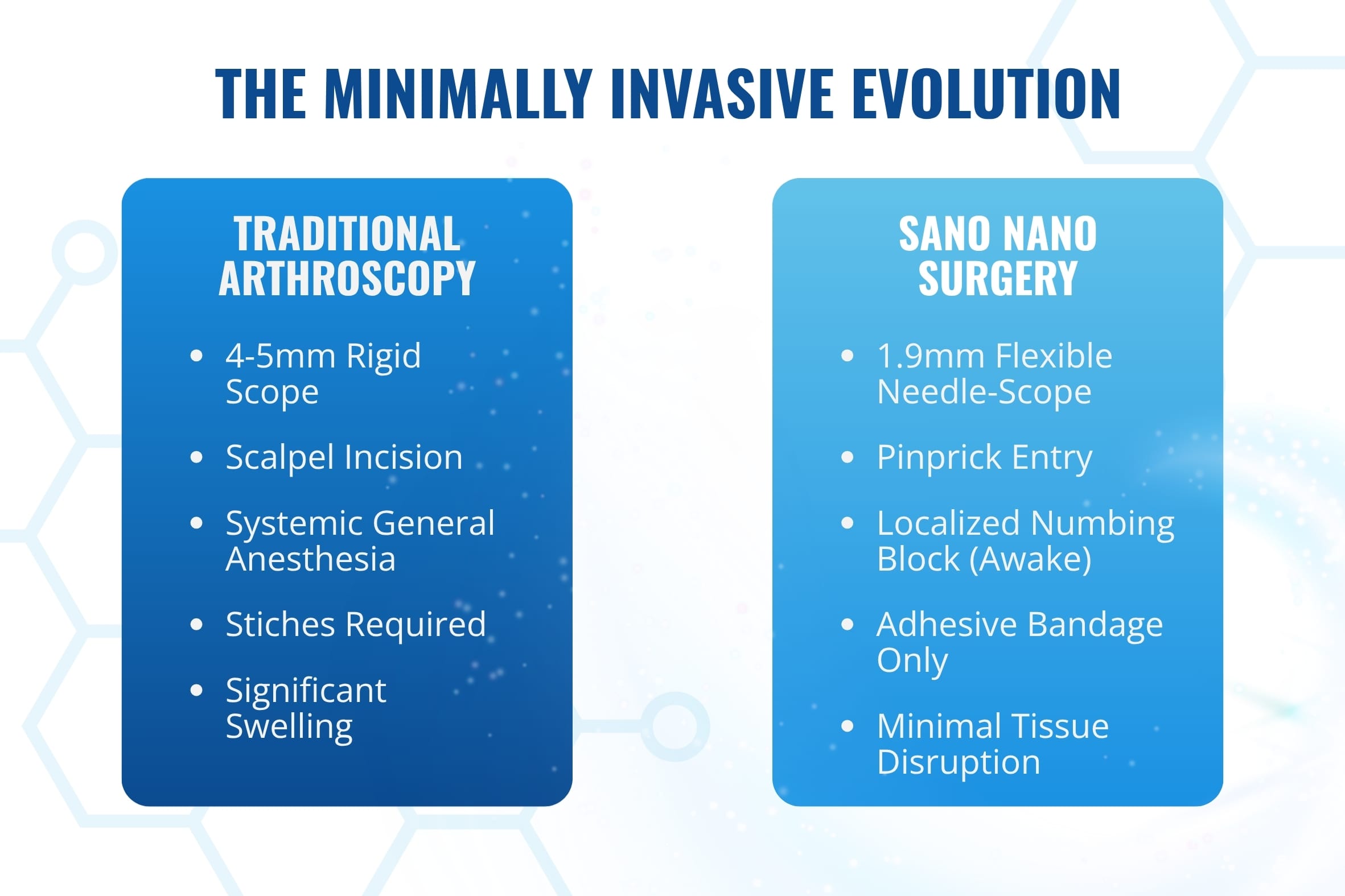
In traditional arthroscopy, surgeons often use a 4 mm to 5 mm rigid scope. With outpatient nano surgery, the scope may be as small as 1.9 mm. Traditional arthroscopy may involve small incisions, stitches or sutures, and general anesthesia, while outpatient nano surgery may use a local numbing block for select procedures, micro-pinprick entry points, and adhesive bandage closure.
 Quick Comparison
Traditional Arthroscopy
- 4 mm to 5 mm rigid scope
- Often general anesthesia
- Small incisions; stitches may be needed
- More disruption to surrounding tissue
- Swelling may delay early movement
Outpatient Nano Surgery
- 1.9 mm ultra-slim nano-scope
- Local numbing block for select procedures
- Micro-pinprick entry; adhesive bandage closure
- Lower disruption using tiny instruments
- May allow earlier gentle movement
Want the full comparison in a printable format?
Why Patients Ask About Nano Surgery
Many patients begin researching nano surgery because they want to understand whether there is a less invasive option for their knee or shoulder injury.
Common reasons patients ask about nano surgery include:
- Smaller entry points
- Local anesthesia for select procedures
- Less swelling that may support earlier movement
- Bandage-only closure for tiny entry points
- A more realistic return-to-work or return-to-activity plan
- A desire to avoid a longer recovery period when medically appropriate
For active adults, athletes, weekend warriors, and people with physically demanding jobs, recovery time matters. The goal is not just to treat the injury, but to help patients understand their options and make an informed decision with a specialist.
Nano Surgery for Knee & Shoulder Injuries
Recovery, Benefits, and How It Compares to Traditional Arthroscopy
Nano surgery may be used for select knee and shoulder conditions that require arthroscopic evaluation or treatment.
Knee Conditions
For the knee, nano surgery may be considered for certain injuries or joint issues such as:
- Meniscus tears
- Cartilage damage or loose cartilage
- Joint irritation or swelling
- Localized areas that may benefit from arthroscopic evaluation or treatment
Shoulder Conditions
For the shoulder, nano surgery may be considered for certain issues such as:
- Biceps tendon injuries
- Rotator cuff assessment or debridement
- Loose bodies in the joint
- Certain sources of shoulder pain that may require arthroscopic evaluation
Not every knee or shoulder condition can be treated with nano surgery. Some injuries still require traditional arthroscopy or another surgical approach. The best way to know whether nano surgery is appropriate is to meet with an orthopedic specialist who can review your symptoms, imaging, diagnosis, and activity goals.
What Is Recovery Like After Nano Surgery?
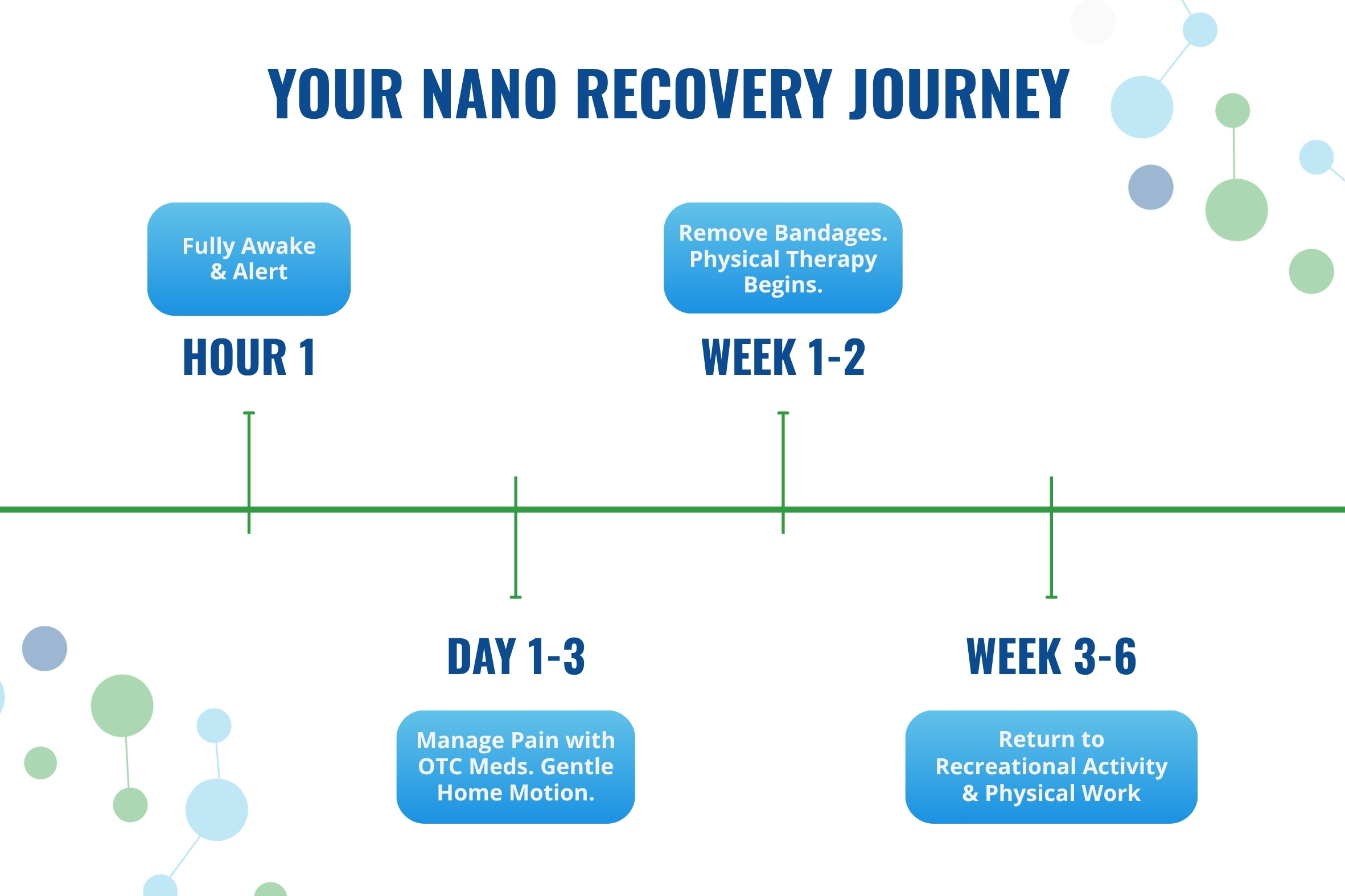
Recovery depends on the specific condition being treated, the procedure performed, your overall health, and your surgeon’s instructions.
For select patients, outpatient nano surgery may allow earlier gentle movement because the procedure uses smaller instruments and may involve less tissue disruption than traditional arthroscopy.
In general, patients often want to know:
- When they can walk or move the joint
- Whether they will need a sling, brace, or crutches
- How much swelling to expect
- When they can return to work
- When they can return to exercise, hobbies, or sports
- Whether physical therapy will be needed
Because recovery varies, your care team will provide specific instructions for your procedure. The first 48 hours are especially important to discuss with your specialist so you know what to expect with movement, weight-bearing, comfort, and activity restrictions.
Could You Be a Candidate for Nano Surgery?
You may want to ask about outpatient nano surgery if:
- You have a knee or shoulder injury that may need arthroscopic care
- You want a less invasive option, if medically appropriate
- You need a realistic return-to-work or return-to-activity plan
- You are concerned about general anesthesia, stitches, swelling, or downtime
- A specialist confirms your injury may be a fit
Only an orthopedic specialist can determine whether nano surgery is appropriate for your specific injury. A consultation can help clarify whether this option makes sense for your diagnosis and recovery goals.
5 Questions to Ask Your Specialist
If you are considering treatment for a knee or shoulder injury, bring these questions to your appointment:
- Am I a candidate for outpatient nano surgery for my specific joint injury?
- Will I need local anesthetic only, or will light sedation be used?
- What will my first 48 hours of movement and weight-bearing look like?
- When can I return to my work, sport, hobby, or daily activity?
- Is this procedure covered by my insurance or Medicare?
These questions are also included in Sano’s printable patient resource, along with a quick comparison of traditional arthroscopy and outpatient nano surgery.
Download PDF: Nano Surgery vs. Traditional Arthroscopy
Use this one-page printable resource to compare procedure differences, review patient benefits, and prepare questions for your specialist.
Take the Next Step With Sano Orthopedics
If knee or shoulder pain is limiting your work, sport, hobbies, or daily life, you may have more treatment options than you realize.
Sano Orthopedics can help you understand whether outpatient nano surgery may be appropriate for your specific injury and recovery goals.