

Everyone has to cope with back pain at some stage. Garden work, a long drive, or lifting a heavy object can leave your lower back stiff and aching. However, if the pain extends from the lower back into the hip or leg, something more specific than a muscle strain may be the cause.
Knowing whether you have general back pain or true sciatica can help you feel more confident recognizing your condition, understanding what to expect, and choosing the right treatment. Below, we cover the causes, symptom patterns, and assessment methods that distinguish the two.
A quick comparison between sciatica and general back pain.
|
Factor |
General Low Back Pain |
Sciatica |
|
Location |
Centered across the lower back or hips |
Lower back, buttock, and down one leg |
|
Pain quality |
Dull ache, stiffness, tightness |
Sharp, burning, or shooting |
|
Tingling or numbness |
Usually absent |
Common, often with leg weakness |
|
Worse with |
Bending backward, twisting, lifting |
Sitting, bending forward, coughing, sneezing |
|
Usual source |
Strained muscles, ligaments, or spinal joints |
A compressed or irritated nerve root |
Understanding General Low Back Pain
Most cases of lower back pain are mechanical, with discomfort due to the spine's structures, such as muscles, ligaments, and the small joints between the vertebrae, rather than a nerve.
The National Institute of Neurological Disorders and Stroke (NINDS) states that around 80 percent of adults will at some time in their lives suffer from low back pain, and it is the leading cause of work-related disability in the United States.
Signs that point toward mechanical low back pain:
- The pain was in the lower back and did not extend down the leg.
- Muscle tightness or spasm that feels worse after sitting or standing still
- Pain that eases with gentle movement, posture changes, or heat
- Normal strength, sensation, and reflexes in the legs
Most muscle strains can improve within a few weeks with light activity, posture adjustments, and temporary limits on heavy lifting or twisting.
What Makes Sciatica Different?

Sciatica is not a disease itself; it's a term for irritation of the sciatic nerve, the largest nerve in the body, which extends from the lower spine down each leg.
The sciatic nerve is made up of the nerve roots in the lower spine and sacrum, extending from L4 to S3; if any of these roots are compressed or irritated, whether due to disc material, bone, or swelling, it is possible for pain, a tingling sensation, or weakness to travel down the leg that it supplies.
A clinical reference from StatPearls, published by the National Center for Biotechnology Information, states that sciatica affects about 10 to 40 percent of people at some stage in their lives, and that symptoms most likely start in a person's fourth decade of life.
Hallmarks of sciatic nerve irritation:
- One-sided pain that spreads: discomfort spreads from one buttock down the back or side of the thigh and usually continues past the knee to the ankle or foot.
- A sharp or burning sensation is usually described as an electric shock or a burning line down the leg, not a dull ache.
- Some people experience tingling, numbness, or weakness, such as pins and needles in certain toes or difficulty raising the front part of the foot when walking.
- The situation is even worse when you sit: sitting puts direct pressure on the nerve pathway, which often causes symptoms to spike. Watch for warning signs like sudden weakness, numbness, or loss of bladder or bowel control, which require immediate medical attention.
Understanding what can lead to sciatica and general back pain can help you recognize early Signs and feel more in control of seeking appropriate care when needed.
What can lead to sciatica:
- A herniated disc occurs when the soft inner portion of a spinal disc bursts through its outer layer and presses on a nearby nerve root.
- In spinal stenosis, the area surrounding the spinal nerves becomes narrower, usually because of age-related changes, and compresses the nerve pathways.
- Spondylolisthesis is a condition in which one bone in the spine slides forward over the bone beneath it, compressing nearby nerves.
- Piriformis irritation occurs when a deep buttock muscle goes into spasm against the sciatic nerve, causing symptoms that seem to come from a spinal problem even though the spine is not the cause.
What can lead to general back pain:
- Muscle strain can occur if you lift with bad technique or make a sudden, awkward move.
- The wearing away of the joints: Everyday use of the small stabilizing joints in the spine can lead to local irritation.
- The sacroiliac joint, which connects the base of the spine to the pelvis, can become stiff or unstable.
- Posture-related fatigue can also weaken the core and lower-back muscles after long periods of slouched, unsupported sitting.
Knowing how specialists evaluate back and leg pain can reassure you that professional help is available and that accurate diagnosis is a key step toward relief.
When a person comes in with back or leg pain, the visit usually begins with a physical examination and a review of the symptoms and medical history. Specialists generally use:
- For the straight leg raise test, when you are lying on your back, your doctor will slowly raise your straight leg; if this action causes a sharp pain to travel down the leg beyond the knee, usually between 30 and 70 degrees of leg elevation, it suggests nerve root irritation rather than a problem that is limited to the muscles.
- A simple neurological examination involves testing the knee and ankle reflexes, asking the person to walk on their heels and toes, and checking sensation down the leg.
- When needed, X-rays can rule out alignment problems, and MRI is used when a provider needs a more detailed view of the discs and nerves, typically in cases with severe, persistent symptoms or weakness.
Common Approaches to Relief
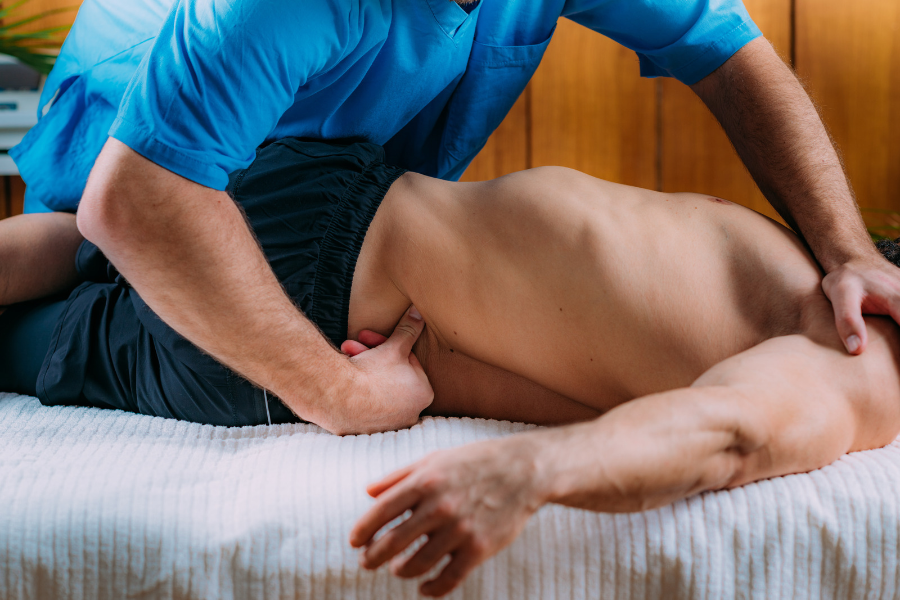
Most cases of back pain and sciatica improve on their own without surgery, and it is generally best to stay reasonably active rather than stay in bed for several days, since prolonged inactivity can hinder healing.
Physical therapy and movement-based care
A physical therapist can evaluate how you move and help you do exercises, including mild extension stretches, nerve-gliding movements, and core stabilization exercises, to reduce pressure on irritated structures.
Targeted injections
If the nerve pain is severe enough to prevent a person from taking part in physical therapy, then an image-guided epidural steroid injection can be used to deliver anti-inflammatory medication close to the nerve root. This may reduce swelling and make movement-based therapy more tolerable.
Minimally invasive procedures
If the symptoms do not get better with non-surgical treatment or if the weakness worsens, then the doctors might carry out procedures such as microdiscectomy (involving the removal of the part of the disc that is pressing on a nerve) or a minimally invasive laminectomy (which involves creating more space around a nerve that is compressed).
When to Seek Urgent Evaluation
Most back and leg pain is not an emergency, but a few warning signs call for immediate medical attention:
- Sudden loss of bladder or bowel control
- Numbness in the groin or inner thighs
- Rapidly worsening leg weakness or a foot that drags while walking
- Severe back pain paired with unexplained fever or chills
If you see any of these signs, or if pain occurs after a fall or some other trauma, schedule an appointment with our spine team.
Frequently Asked Questions
Can general back pain develop into sciatica over time?
It can. If the lifting technique is poor or there is continuous overuse, repeated stress on a disc may eventually cause it to bulge or herniate and thus put pressure on a nearby nerve root.
What is the typical duration of a sciatica flare-up?
Recovery time depends on the cause and severity. In most cases, minor episodes improve over a few weeks with movement, physical therapy, and activity changes, although recovery can take longer or require further assessment, especially if symptoms stay the same or worsen.
Will walking help with sciatica?
Walking is usually a safe, low-impact activity for people with leg pain from nerve problems; it promotes circulation and movement in the spine and is generally better tolerated than sitting for long periods or staying completely still, although each case is different.
Learn More
For more information about back pain from federal health agencies, see the NINDS Low Back Pain Fact Sheet and the Sciatica overview provided by the National Center for Biotechnology Information.